Editor’s Note: The author of this article is an adjoining property owner to one of the proposed solar projects. She is also directly related to one of the families who have signed a lease agreement with a solar company.
By Abigail Roberts
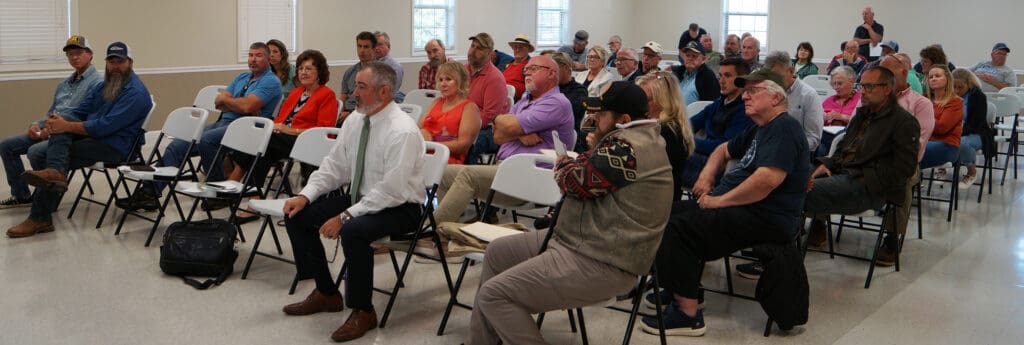
Lincoln County Fiscal Court magistrates heard from a number of people, for and against solar farms, as well as representatives from two solar energy companies on Tuesday.
In short, a lot happened and nothing happened at all.
A working meeting was held at 8 a.m., prior to the regular meeting at 9 a.m.
Candela Renewables has proposed a 200-225 MW photovoltaic solar-plus storage facility, with construction expected to begin in 2028.
The project includes a little under 2,800 acres in Preachersville, with the current plan utilizing about 1,100 of those acres for solar panels.
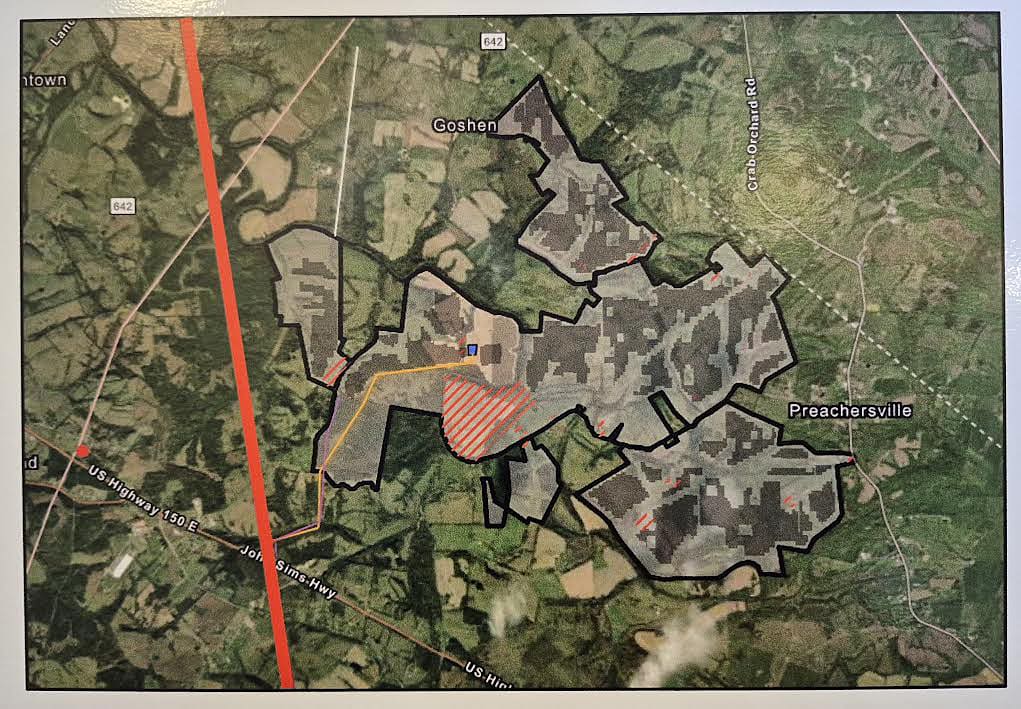
Clearway Energy currently has about 2,000 acres under lease in Lincoln County. The company says they will not be utilizing all of that acreage, due to contours of the land, natural barriers, county setback requirements etc., but they are still in early planning stages.
Clearway has also proposed a $3 million community benefit fund, to be distributed locally however a local board would see fit.
During the last fiscal court meeting, magistrates accepted the recommended ordinance from P&Z but reverted it back to the original ordinance that was sent to P&Z.
On Tuesday, Lincoln County Attorney Daryl Day informed magistrates, after speaking with other legal counsel, that they had 60 days to vote the P&Z recommendation up or down, or it would become law due to inaction.
Magistrate David Faulkner argued the action magistrates took at the last meeting was unconstitutional and needed to be fixed. He also argued that people who have signed leases with solar companies should be grandfathered in because they signed leases under the existing zoning ordinances.
Faulkner made a motion to rescind the zoning ordinance from the last meeting and revert back to the ordinance recommended by P&Z.
“I misspoke last time,” Day said. Day said he spoke with other legal counsel and did some research following the last meeting.
“I don’t think it’s a constitutional question, I think it’s a KRS. 100 question,” Day said.
Day said zoning amendments can start with Fiscal Court or P&Z.
“Wherever it starts, it has to go through Planning and Zoning. They have to hold a public hearing. They have to discuss and then they have to propose something back to you all,” he said. “…you can make minor changes to it.”
Day said he doesn’t think they can “just scrap it” and go to something totally different.
But there is no case law to refer to on the topic that Day can find.
“There’s some ambiguity in the law about how much amending you can do,” he said. “I’m not pro-solar or anti-solar, my whole goal is, whatever you all pass, I want to know that I can defend it in court…”
Day said he doesn’t think magistrates can revert the P&Z ordinance back to the original.
Faulkner asked if he was correct that people who have signed leases have signed under the existing law.
Day said he believes it is, under the Kentucky Constitution (section 19) which prohibits the passage of ex post facto laws and laws that impair the obligation of contracts.
“There is statutory law that says an option to purchase is a contract,” Day said. It would be up to a judge to decide if that is a correct interpretation, he added.
Day also recommended updating the definition of prime farmland to reflect the federal definition.
Magistrates have until Oct. 20 to take action on the P&Z’s recommended ordinance, Day said.
Faulkner’s motion died for lack of a second.
Judge Executive Woods Adams asked if there was a motion to approve a second reading of the original zoning ordinance.
As someone who has farmed in Lincoln County his whole life, and is still farming, Magistrate Joe Stanley said this has been a tough decision.
“I have friends on both sides of this,” he said. “This is the hardest decision I’ve probably ever had to make on Fiscal Court and 5,000 acres of Lincoln County farmland hangs in the balance. There’s money in the solar system and there’s money in farming.”
Stanley said it would be a tremendous loss of grain crops and cattle to take 5,000 acres out of Lincoln County farms.
The solar companies have said some of the farmers who have signed leases plan to continue to farm some portions of their farm, and others have agreed to graze sheep within the solar farms.
“I feel like, as a whole, the future of Lincoln County is in agriculture,” Stanley said. “I think we’ve had our chance to farm this land and do what they will with it and I think we need to not take that opportunity away from our younger guys…it’s been hard and I may be wrong, but that’s all I’ve got.”
Stanley made a motion to pass the second-reading of the P&Z ordinance that was reverted back to the original ordinance, with the addition of the federal definition of prime farmland.
The motion died for lack of a second.
After further discussion, Faulkner made a motion to approve the first-reading of the P&Z recommended ordinance.
The motion died for lack of a second.
Magistrate Dan Gutenson said the fiscal court is not kicking the can down the road, but making sure they are doing what is best for the future of Lincoln County.
“We’re looking at what is best for Lincoln County now, but also the future because what Planning and Zoning sent us did not address the future really in depth,” Gutenson said. “The biggest solar project I can find in Kentucky is about 1,600 acres total and this is bigger than that for sure.”
By law, the issue was tabled as no motions were seconded. Magistrates have until Oct. 20 to take action on the P&Z recommendation, according to Day.
The next regular Fiscal Court meeting will be held at 9 a.m. on Sept 23 at the Wellness Center in Veterans Park.