
Editor’s Note: The author of this article is an adjoining property owner to one of the proposed solar projects. She is also directly related to one of the families who have signed a lease agreement with a solar company.
By Abigail Roberts
Candela Renewables hosted an open house event Sept. 3 to share information about the company’s proposed solar development project in Lincoln County.
The three-hour open house was held at the L&N Depot in Stanford and allowed people to view informational print outs, see maps of the project area, as well as ask questions.
Candela Renewables has proposed a 200-225 MW photovoltaic solar-plus storage facility, with construction expected to begin in 2028.
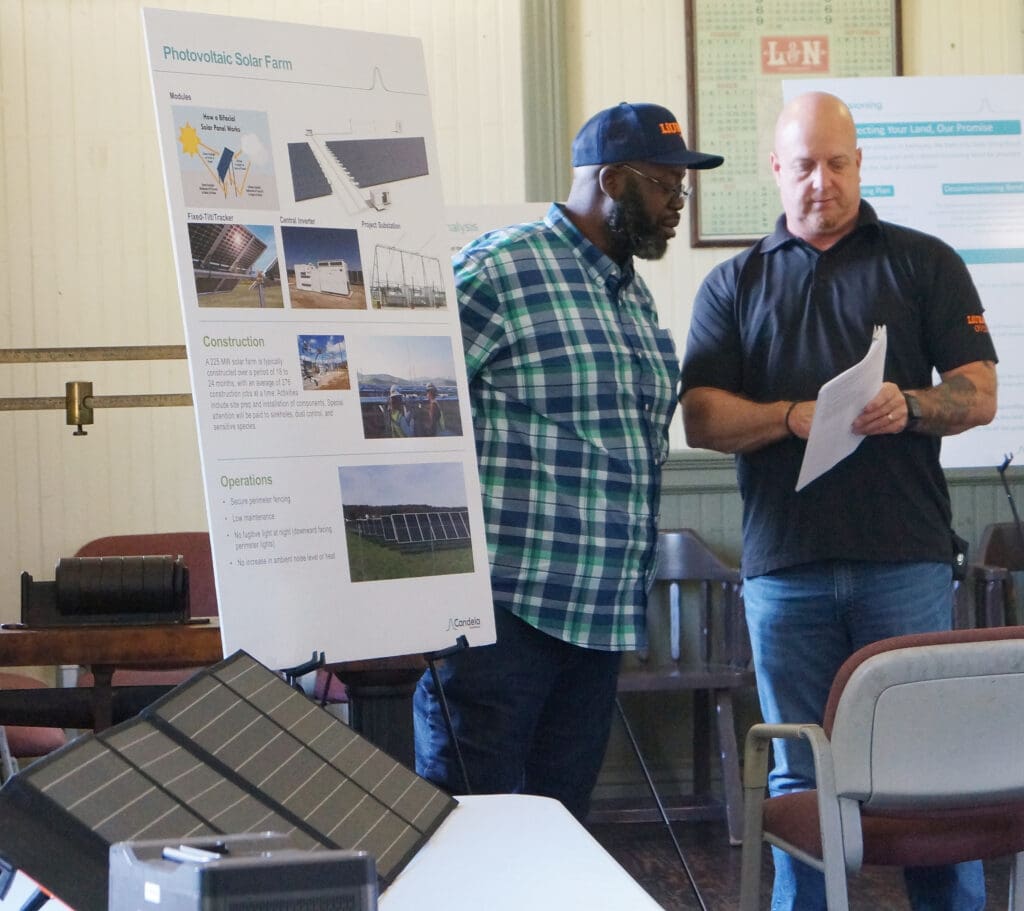
The project includes a little under 2,800 acres in Preachersville, with the current plan utilizing about 1,100 of those acres for solar panels. The project life is expected to be 30 to 40 years.
In a phone interview, Tom Dandino, Senior Analyst of Development & Origination for Candela Renewables, said the project straddles Preachersville Road. The Dix River, which runs through Preachersville requires setbacks for its protection, he said.
“Candela’s goal is to minimize any impact to the land, if possible,” he said. Some of the landowners who have signed on are current or retiring farmers and some of them have agreed to continue grazing cattle in some areas of the project, as well as sheep.
There are about 15 different farms, with about 12 different land owners, who have signed on with Candela’s solar project in Lincoln County.
Jim Woodruff, Senior Vice President of Public Affairs, said the construction includes pounding steel posts directly into the ground.
“There is little disturbance to topsoil because of that,” Woodruff said. “…Over time, solar technology has evolved to a point where we can follow all of the micro-topography, leave the drainage in place to the fullest extent possible, and leave topsoil in place so it’s not graded.”
Woodruff said there will be some limited grading but the solar panels undulate over the land so it is not a flat sea of panels.
“It’s light on the land. We’ve learned over time that that has a number of advantages in terms of preserving the agricultural features of the land. It also means that at the end of the useful life of the project, when we decommission it and take everything out, you’ve left the land in its prime state and returned it to its original use,” Woodruff said.
The state of Kentucky requires solar companies to have a third-party bond in place to cover the decommission costs. So if Candela or any other solar company were to go bankrupt, the money would still be there to take the project down and return it to open farmland, he said.
Woodruff said the bond is fully-paid and updated every five years.
“It’s a way of preserving farmland. It’s very different, for example, than putting in an Amazon distribution center, or a Walmart, or residential housing where you subdivide the land and put in roads and sewers,” Woodruff said. “There’s none of that here. The land will not be subdivided for housing and can be returned to agricultural use. Some people say they have improved the quality of soil by taking it out of rotation and we don’t typically use herbicides, pesticides, that sort of thing.”
Lincoln County was chosen for a variety of reasons, Woodruff said, including its accessibility to an existing 345 Kv line.
“The plan is to tap into that line to interconnect to the grid,” he said.
Concerns were raised during a Lincoln County Fiscal Court meeting about solar farms spreading across all of Lincoln County’s prime farmland.
“The transmission grid only has so much room for solar projects on it,” he said. “We’ve done what’s called an injection study to see how much capacity there is on the transmission system there. If our project were built, and if Clearway Energy’s project were built, there would be no more capacity on the transmission system.”
Matt Kiehlmeier, Real Estate Manager for Candela Renewables, said it is hard to say how much of the solar panels will be visual but Preachersville has a lot of natural buffers that will remain in place.
“I don’t think anyone will notice a severe change to landscape in the area because near the road it is either too thick or too steep to build, so we’re going to set back kind of tucked in amongst those farms, back off of the road,” Kiehlmeier said.
The projects will be enclosed with a standard 6-foot-tall chain-link fence with an additional 1 foot of barbed wire as required by federal standards.
The ordinances currently being considered by the fiscal court require visual/vegetative screens to help mitigate the visual impact.
Woodruff said the company is also willing to work with locals and landowners to plant native plants to help reduce the ability to see the solar panels.
“We want to listen to what people think is aesthetic or would work,” he said.
Adjoining and nearby property owners have also raised concerns about potential negative effects to property values.
Keihlmeier said a recent study done by the Virginia Tech University examined how solar farms affect property values.
“What they found is, as far as residential goes, there has been very little effect, almost zero on property values, and on farmland, agricultural land, values actually went up,” he said. “They didn’t give a specific reason for that. We can probably draw our own conclusions that those farms will become attractive for solar development and you probably have a little more competition for a little less farmland for lease farmers, that kind of thing.”
The study states residential homes within three miles of a site lost about 4.8% on average. Agricultural and vacant land within two miles of the site saw a 19.4% increase in value.
You can view the study here: https://news.vt.edu/articles/2025/06/solar-property-value.html
According to informational print outs available during the open house, through the use of Industrial Revenue Bonds and PILOT (payment in lieu of taxes), the company says it will generate 18 times the current revenue from the land to the county.
The company says construction would take 1-2 years and create up to 300 construction jobs on average. The project will create 2-3 permanent jobs.
The energy generated by the solar is expected to be sold to Louisville Gas & Electric and Kentucky Utilities (LG&E-KU).
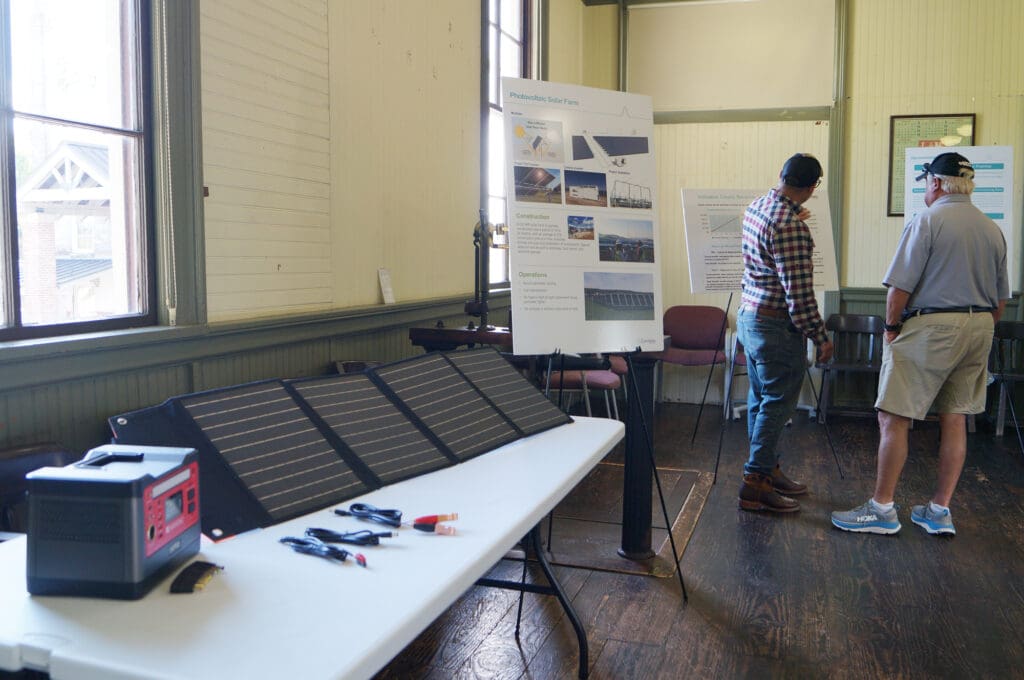
Wednesday night’s open house lasted about 3 hours with people coming and going to gather information and ask questions.
Clearway Energy also has a proposed solar project in Lincoln County. Barry Matchett, Head of External Affairs, said Clearway currently has about 2,000 acres under lease.
“We absolutely will not use all of that because of the contours of the land, natural barriers, county setback requirements etc.,” Matchett said.
SO YOU KNOW:
Magistrates are expected to hold a working meeting with solar representatives on Sept. 9 at 8 a.m., prior to the regular monthly meeting at 9 a.m. Both meetings will be held at the Wellness Center in Veterans Park and are open to the public.
