
Editor’s Note: The author of this article is an adjoining property owner to one of the proposed solar projects. She is also directly related to one of the families who have signed a lease agreement with a solar company.
By Abigail Roberts
Proposed solar projects in Lincoln County have been the main topic of the last month-and-a-half of Fiscal court meetings and the Sept. 23 meeting was no different.
This time, magistrates heard mostly from people opposed to solar farms, who say they were unaware of the proposed projects and have many questions.
On Aug. 21, Lincoln County Planning and Zoning held a two-hour public hearing on a new zoning ordinance that would have, through new zoning regulations, prohibited solar farms in the county.
After two hours of discussion from those for and against solar, zoning commissioners returned an amended ordinance for the Fiscal Court to consider.
That ordinance included language that would grandfather-in current solar leases, change setbacks and include language that attempts to protect “prime farmland.”
The ordinance was returned to magistrates for consideration.
On Sept. 3, Candela Renewables hosted an open house event in Stanford in an effort to answer questions and provide information about their proposed project.
Magistrates debated the P&Z recommended ordinance on Sept. 9. After lengthy discussion, magistrates agreed they needed more time to gather information, do research and talk to constituents.
On Tuesday, magistrates took action on the P&Z- recommended ordinance.
In multiple 3-to-1 votes, magistrates approved changes to the ordinance including:
• removing the language that allowed current options-to-lease agreements to be grandfathered-in;
• changing setbacks for Solar Energy Systems (SES) to 1,000 feet from residential property lines; 1,000 feet from commercial or industrial property lines; and 1,000 feet from the center line of any public road;
• adding protection of “prime farmland” with the federal definition (7 CFR Part 657).
Magistrate David Faulkner voted against each motion, as well as the first-reading.
In a 3-to-1 vote, magistrates passed the first-reading of the amended ordinance.
Push back on solar
Some adjoining property owners argued they were not informed of these projects and raised several questions about the effects of solar farms.
A map of current solar leases recorded in Lincoln County was provided to attendees. The map includes about 6,500 acres of farmland.
Solar companies reiterated Tuesday that while the map might show the entire farm, the number of acres that will actually be utilized by solar will be less than that.
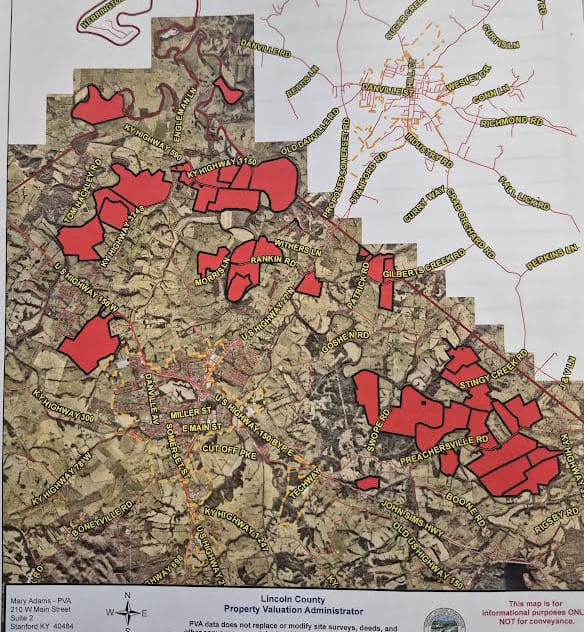
For example, Candela Renewables has a little under 2,800 acres under leases in Preachersville, but they said their current plan will utilize about 1,100 of those acres for solar panels.
Clearway Energy and Candela Renewables have multiple leases in the county but Adams said they are not the only companies seeking projects in the area.
Magistrates heard from multiple people who had not spoken at previous meetings.
Adrian Waddell, who lives in the Stingy Creek area, raised multiple concerns including the amount of land being considered for solar, the fencing that may affect the travel of wildlife, the safety of the Dix River and its tributaries, and the negative effect the solar projects could have on property values of adjoining land.
Waddell said his taxes will keep going up while his property value will go down.
Others echoed Waddell’s concerns about toxic waste, soil compaction and leaving less farm land for young farmers in the future.
Local resident and real estate agent Curtis Brown said he was concerned with the fact that the acreage keeps growing and many people in the county are unaware.
Once all of those who hadn’t spoken at previous meetings were done, the floor was opened to anyone else in attendance who would like to speak.
Several pro-solar attendees voiced concern over the legality of negating options-to-lease that were signed under existing laws.
Michael Rankin, who lives in Preachersville, said emotions are high and everyone needs to remember that they are all neighbors. Rankin urged the group to do research responsibly, using accurate, up-to-date information.
Linda Holtzclaw spoke in support of the original P&Z ordinance, which she said was a compromise that protected Lincoln County while honoring current projects under contract.
Anna Rodger, a representative of Clearway Energy, said solar companies always lease more land than they plan to use. She also said that solar projects are heavily regulated by the state and federal regulations which include geo-technical studies, wetland studies, engineering and environmental studies. Rodger also said they are required to have a third-party bond to cover all costs associated with decommissioning a project.
Tuesday’s discussion lasted for about two hours.
Legal questions raised
Can the Fiscal Court make major changes to an ordinance recommended by P&Z? What constitutes a minor or major change to an ordinance?
Can the Fiscal Court pass a new ordinance that negates current options-to-lease agreements that were signed under the previous laws?
These are the main legal questions that have been raised throughout the solar farm debate.
Lincoln County Attorney Daryl Day told magistrates during the Sept. 9 meeting that after speaking with several attorneys, he believes magistrates could make “minor” changes to the P&Z ordinance but not major changes.
Day cited KRS 100 which lays out the process for amending zoning maps. The statute requires a public hearing and a recommendation from the planning commission before the local legislative body can act.
He also said that he believes the current options-to-lease agreements constitute legal contracts and are thereby protected by the Kentucky Constitution, Section 19.
That portion of the state Constitution refers to “Ex Post Facto Law” or “law impairing contract forbidden.”
It reads: “No ex post facto law, nor any law impairing the obligation of contracts, shall be enacted.”
These questions were once again raised during the Sept. 23 meeting.
Magistrate David Faulkner said he believes the fiscal court is legally required to grandfather-in the current leases, in accordance with the state Constitution.
He also argued that magistrates shouldn’t ignore what P&Z has recommended.
Local attorney John Hackley, who currently has an option-to-lease with a solar company, said the Fiscal Court has heard from not only the P&Z attorney, but also the county attorney, that they believe the current contracts must be honored.
Hackley asked if they have received any legal opinion that contradicts that legal counsel.
Judge-Executive Woods Adams III said that is for another court to decide, not the Fiscal Court.
SO YOU KNOW
The next regular Fiscal Court meeting will be held Oct. 14 at 9 a.m. at the Wellness Center in Veterans Park. Magistrates are expected to consider a second-reading of the amended zoning ordinance. The meeting is open to the public.
